Naples’ Filangieri Museum: how can a collection teach you to look?

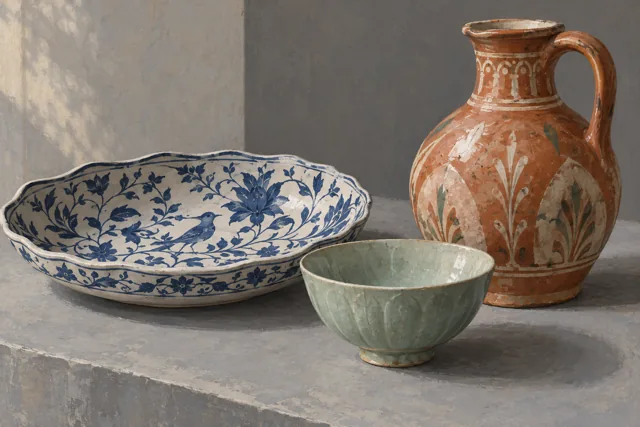
A bowl, a painted panel and a piece of metalwork may seem like three unrelated museum stops. At Naples’ Filangieri Museum, try treating them as three answers to the same question: how did someone turn a material into something worth looking at? That question gives a mixed collection a satisfying thread. You can enjoy its variety without trying to memorize a catalogue or decide which object deserves the greatest admiration.
The museum occupies Palazzo Como on Via Duomo. The Campania regional cultural authority records its opening in 1888 and explains founder Gaetano Filangieri’s educational ambition: the collection would offer models to young artists and craftspeople. That purpose makes close looking central to the visit. These were objects to learn from as well as objects to possess.
Start with a material you can recognize
Choose something that draws your eye before reading every nearby label. Perhaps it is glazed ceramic, polished metal or carved wood. Describe what you can actually see: a reflective surface, a narrow handle, a repeated border, a change in colour. Then read the label to test your first impression. A familiar-looking object may come from a different place or period than you expected. That small correction is useful knowledge, not a failed guess.
Our guide to looking at ceramics in the Duca di Martina Museum offers a complementary exercise. Here, however, keep the comparison broad. A painted line and a chased metal surface achieve their effects through different actions. You do not need to know every technical term to notice where precision, repetition or a deliberate irregularity gives an object its character.
Notice how the room shapes your attention
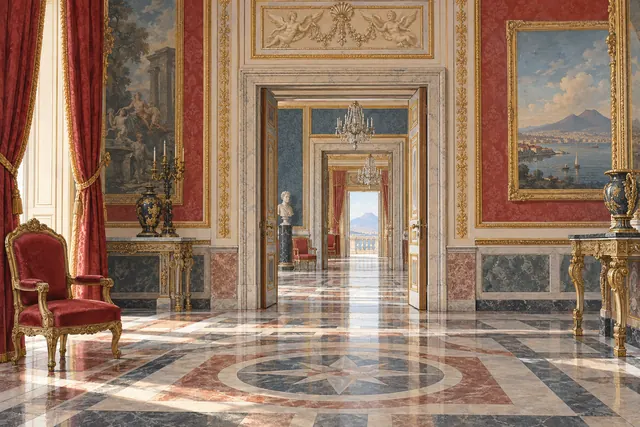
The museum’s own presentation introduces rooms dedicated to the founder’s parents, Carlo Filangieri and Agata Moncada. It also describes the Agata room’s majolica floor and the library’s furnishings and books. This is a collection presented through an architectural setting, rather than a row of objects floating in neutral space. Look at the relationship between the thing in a case and the surfaces surrounding it.
Ask whether a pattern feels easier to see against dark wood or pale stone. Does a group of related objects make a particular shape more apparent? Can you distinguish decoration on an object from decoration belonging to the room? These are observations about your encounter with the display. They do not establish the founder’s exact intentions for every arrangement, and today’s presentation should not automatically be treated as an untouched nineteenth-century installation.
Make one comparison, then let the collection surprise you
Pick two objects with an apparent connection: similar colour, similar purpose, or a shared motif. Compare their proportions and the parts that would have been handled. Where a date, maker or place is supplied, use that information carefully. Resemblance alone cannot prove direct influence. A useful note might say that two handles solve a similar problem differently, rather than declaring that one maker copied another.
This method travels well. In San Gregorio Armeno’s workshops and displays, it can turn browsing into an attentive look at making. If your journey continues around the bay, Sorrento’s inlaid wood offers another material language. The point is to carry a question between places while respecting their different histories.
If you are keeping notes, give the object a short description that you could recognize later: its shape, material and one distinctive feature. Record the label’s wording for a maker or date separately from your own response. This small separation makes a travel notebook much more useful when several museums begin to merge in memory.
Plan a visit with room for looking
Check the museum’s current opening arrangements, admission conditions and accessibility directly before travelling. A room described on a website is not a guarantee that every object or space will be available on your date. If a particular collection matters to you, ask about it specifically. Leave photography, sketching and access to any research material subject to the museum’s rules; a library in the building does not imply unrestricted handling of its books.
Via Duomo makes this a useful part of a historic-centre day, but resist turning the surrounding streets into a sequence of hurried admissions. Our first Spaccanapoli walk can help with the wider setting. Compare the Naples arts and cultural experiences if you want a guided element, checking precisely what each option includes. A rewarding outcome is modest: leave remembering one object clearly, one technique more intelligently, and one question you would like to pursue.
Sources & further reading
Turn a good read into a great day.
Find a highly rated Neapolitan experience that brings these stories to life.
Explore related experiences →