Castel Capuano in Naples: how did a royal castle become a courthouse?

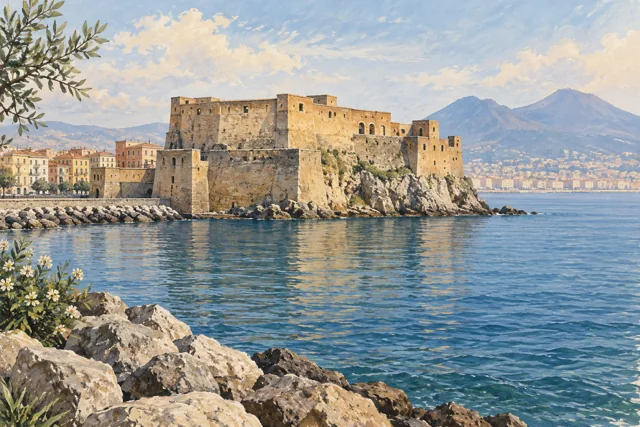
Castel Capuano rewards a question more interesting than whether it looks sufficiently castle-like: what happens when a royal residence becomes a place where a kingdom administers justice? At the eastern end of Via dei Tribunali, the building offers a way to think about Naples through institutions as well as rulers. Its history does not stop with medieval stonework. Later uses changed what people came here to do, how they entered and what authority the rooms were expected to express.
Start with the distinction between historical interest and public access. A building can matter enormously without operating as a walk-in museum every day. Before arranging an interior visit, find a current, dated opening or organized visit and confirm its scope. Otherwise, make the exterior and surrounding streets the subject of your stop, with an alternative indoor visit already in mind.
A castle at a city edge
The Court of Appeal’s account places Castel Capuano at the end of the ancient major decumanus, with access from Piazza Enrico De Nicola. Its name refers to the nearby gateway toward Capua. The institution traces its origins to the twelfth-century Norman kingdom and describes successive changes under later rulers. Royal residence and fortified position were parts of the same story, rather than two neatly separated identities.
Try reading that position before searching for decorative details. A major route, a gateway and a substantial building form a relationship that a close-up photograph cannot show. Stand somewhere safe and observe how streets approach the site. Ask what an arriving person would have encountered, while remembering that the present streetscape is the result of many later changes. A modern view helps frame a historical question; it cannot restore a vanished medieval city around you.
Judicial use reshaped the building
The Court of Appeal records the sixteenth-century adaptation ordered by Pedro de Toledo for courts and imprisonment. It also describes later judicial rooms, including an important hall with painted allegories and jurists’ busts. Read those as evidence of a different institutional language: authority communicated through proceedings, professional memory and images, as well as through the mass of a former fortress.
The Italian Institute of Castles follows the building through further alterations and repair. Its account makes a useful corrective to the idea of an untouched castle frozen at its foundation. A surviving wall may belong to one campaign while a window, room arrangement or decorative surface belongs to another. Unless an authoritative label or guide identifies the phase, describe what you see first and keep its date as an open question.
An interior route needs specific confirmation
Touring Club’s notice for a visit on 1 April 2026 is evidence of an organized cultural route, including the Biblioteca De Marsico. It is a past event, not a booking opportunity for your travel date. Such notices are valuable because they show how access may be arranged through a named organizer; they do not prove daily entry or unrestricted access to every room mentioned in a historical description.
For a future visit, ask which spaces are included, whether reservations are required, where the group meets and whether the route includes stairs. Do not infer accessibility from a courtyard photograph. If an advertised route changes, let the confirmed arrangement determine your day rather than trying to enter other parts of a functioning institutional building. There is plenty to understand without turning a closed door into an invitation.
Compare different kinds of power
Our Castel Nuovo arch guide explores how an entrance can stage royal authority. The Castel Sant’Elmo article approaches a different defensive form, while the Royal Palace guide considers ceremonial interiors. Comparing these places does not require seeing them all in one day. A short note after each visit can reveal distinctions more clearly than a rushed castle circuit.
A good comparison might ask what each building controlled, whom it received and which image of authority it presented. Do not turn the answer into a simple story of progress from rough fortress to elegant palace. Different functions coexisted, and later occupants often reused earlier architecture because it remained useful, prestigious or difficult to replace.
Give the surrounding city time
Choose a route from our Naples history experiences only after checking its actual itinerary and inclusions. If your wider trip includes another city, Italy Tour Hub’s guide to urban historical layers provides a helpful method of comparison. Castel Capuano’s strength is precisely that it resists a single label. It invites you to notice how a city keeps putting an inherited building to work, while preserving traces that do not all belong to the same century.
Sources & further reading
Turn a good read into a great day.
Find a highly rated Neapolitan experience that brings these stories to life.
Explore related experiences →