San Giovanni a Carbonara in Naples: how do you read a monumental tomb?

A monumental tomb asks you to do several kinds of looking at once. There is a person to remember, a sculptural arrangement to understand and a building whose sacred purpose continues around it. At San Giovanni a Carbonara in Naples, start with a simpler question: how does the monument direct your eyes? You do not need to identify every figure immediately. A slow look at scale and placement will give the names you read later somewhere to belong.
Notice the approach before entering
The diocesan museum network places the church’s foundation in the fourteenth century and its history within the Augustinian community. Its account also identifies the later piperno staircase associated with Ferdinando Sanfelice. This means the approach and the medieval foundation belong to different moments. A dramatic entrance is not a reliable date stamp for everything beyond it. Stop in a safe place, clear of other visitors, and notice how the steps mediate between street and church.
This habit is useful elsewhere in Naples. Donnaregina’s two churches encourages a comparison between neighboring sacred spaces with different histories. Here, you can make a similar distinction within one complex. An architectural visit becomes much clearer when you ask which part you are actually observing instead of assigning the whole place one style.
Look up in stages
The tomb of King Ladislao rises behind the high altar. The diocesan account describes a composition organized in successive levels, including virtues, royal figures, the reclining king and an equestrian figure above. Take those as a guide to looking, then give the arrangement time. What feels close to the viewer? What is elevated beyond ordinary human reach? How does the height change the relationship between the commemorated ruler and the surrounding church?
These are questions about visual choices, not a verdict about the ruler’s character. A tomb is a commissioned representation. It selects the qualities and relationships its patrons wished to preserve. The language of honor can be read critically without forgetting that the place is also a setting for devotion and remembrance. Avoid treating an impressive memorial as a neutral biography carved in stone.
Separate an observation from an identification
Try keeping two short mental lists. On one side are things you can see: a standing figure, a canopy, a change in scale, a horse above the rest of the composition. On the other are things a reliable guide identifies: names, dates, symbols and patronage. When the two lists meet, the monument becomes more legible. When they do not, it is perfectly reasonable to leave a question open rather than assign a saint or virtue by guesswork.
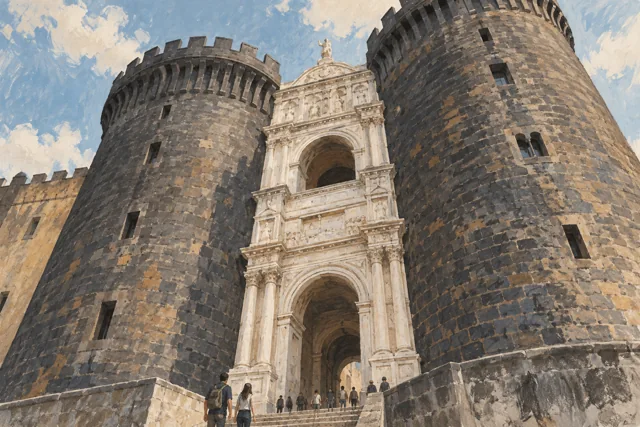
A distant figure may be difficult to inspect without specialist photography. Do not lean across barriers or use flash to solve that problem. Looking from the permitted area is part of the experience of a tall monument. Its distance from your eye is itself a design choice. Our discussion of Castel Nuovo’s triumphal arch offers another Naples example of political commemoration, this time at a monumental entrance rather than within a church.
Let the neighboring spaces change the comparison
The Caracciolo chapels provide another layer of commemoration within the complex. Follow the current visitor route and its interpretation instead of assuming every chapel or adjoining room is open. Compare the relationship between architecture and memorial: does the setting gather your attention inward, or does the monument announce itself across a larger space? The question remains useful even when access allows only a brief view.
At Sant’Anna dei Lombardi, painting and wood inlay offer a different lesson in how a room shapes attention. Across the network, Verona’s Scaliger tombs makes an illuminating comparison with dynastic commemoration in another city. The comparison is about strategies of remembrance, not an assertion that the monuments share an artist, commission or exact meaning.
Check the ticket boundary
The diocesan visitor site distinguishes the church visit from the separately presented Sacrestia Vasariana experience. Read the current arrangement for your chosen day and ask which spaces a reservation includes. A tour bearing the church’s name may have a more specific scope than the entire complex. Worship, conservation and scheduled activities can also affect access. If stairs or standing time are a concern, confirm the practical route rather than relying on a photograph of the facade.
The municipal account of nearby Parco Re Ladislao adds the history of a former enclosed Augustinian garden. Treat that as useful context, not proof that the garden gate will be open or that admission is part of a church booking. One confirmed visit is more satisfying than a chain of assumed entrances.
Browse our Naples history experiences when a guided explanation would help, checking the actual itinerary before reserving. Leave room afterward to remember one relationship: tomb and altar, figure and canopy, street and staircase. A monumental tomb becomes approachable when you stop asking it to tell its entire story at once.
Sources & further reading
Turn a good read into a great day.
Find a highly rated Neapolitan experience that brings these stories to life.
Explore related experiences →