Naples’ Donnaregina: how do two churches tell different stories?

Old and new are relative words in Naples. At Donnaregina, the “new” church belongs to the seventeenth century, while its older neighbor takes you into a different architectural world. Visiting the complex becomes more rewarding when you treat those names as the beginning of a question. What changed between the two spaces, and what did their builders want people to notice?
The diocesan museum’s official accounts of Donnaregina Vecchia and Donnaregina Nuova provide the historical starting points. Keep those accounts beside your observations rather than trying to memorize an entire sequence of names. A contrast in light, a change in scale or the position of a choir can make a complicated history easier to understand.
Begin with the meaning of “old”
The museum connects the Gothic rebuilding of Donnaregina Vecchia with Maria of Hungary and dates the completion of the church to 1316. Her funerary monument is part of that history of royal patronage. This gives you a useful distinction: a church can serve a religious community while also preserving the public memory of an individual benefactor.
Look first at the relationship between the nave, its supports and the elevated choir. Instead of deciding immediately whether the room feels grand or intimate, ask how its separate levels organize attention. Who could see whom? Which parts of the architecture lead your eye upward, and which keep it moving toward the end of the church? These are questions to explore with the interpretation available during your visit, not answers to invent from appearance alone.
Read the new church as another project
The official history places the beginning of construction of Donnaregina Nuova in 1617, when the Poor Clares sought a Baroque church. The older church subsequently belonged to the enclosed convent area. That change matters: the two buildings were not simply competing entries in an architectural beauty contest. They formed part of a religious institution whose spaces and needs developed over time.
In the newer interior, compare broad painted surfaces with the more structural rhythm you noticed in the older building. Polychrome marble, a painted vault and the framing of individual works can direct attention in different ways. Choose one view where several materials meet. Ask how color joins those surfaces together, or makes one part stand apart from its neighbors.
Do not make style do all the explaining
“Gothic” and “Baroque” are useful introductions, but neither word explains every object in a room. Buildings undergo alterations, repairs and changes of use. The museum’s account also describes twentieth-century work separating the two churches and recovering aspects of the older one. What you see therefore includes later decisions about how the past should be presented.
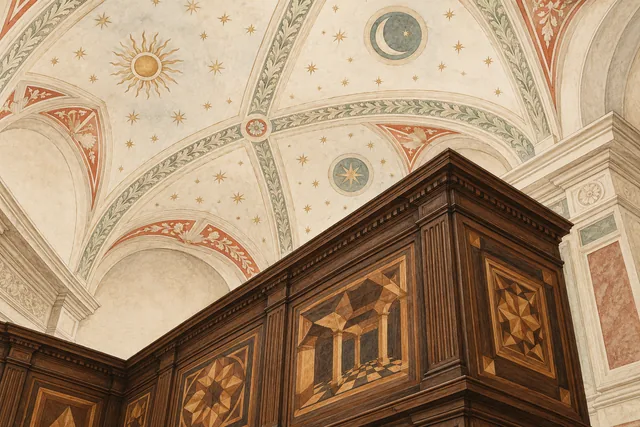
Our guide to Santa Chiara’s cloister offers another Naples exercise in reading color and setting. At Sant’Anna dei Lombardi, painted ceilings and wood inlay invite a different comparison between whole rooms and close detail. Let each place retain its particular history rather than sorting everything into a single city style.
Separate evidence from an attractive story
A label identifying a patron, artist or restoration supplies information that an unaided eye cannot. When an attribution is qualified, preserve that qualification in your notes. A painting associated with a workshop should not become a securely documented work by its master merely because the simpler version is easier to remember.
The same care helps when comparing Donnaregina with Pio Monte’s art and charitable setting. If your journey also includes Verona, San Fermo Maggiore’s layered church spaces provide a useful separate example of how one religious site can resist a single-period description.
Plan around the rooms actually available
Consult the museum’s current visitor information for your date and confirm which parts of the complex are included. An older dated announcement on a venue website is not automatically a present closure notice. Ask directly if access to a particular church, choir or exhibition is essential to your plans, and respect worship and any photography restrictions.
The Naples arts and events collection can help you compare separately described cultural experiences. Leave room afterward to write down two differences you actually observed and one question you still have. That modest record is often more useful than a crowded list of dates: it preserves the moment when two nearby churches began to tell distinct stories.
Sources & further reading
Turn a good read into a great day.
Find a highly rated Neapolitan experience that brings these stories to life.
Explore related experiences →