Naples’ Villa Pignatelli: how can a house museum reveal collecting choices?

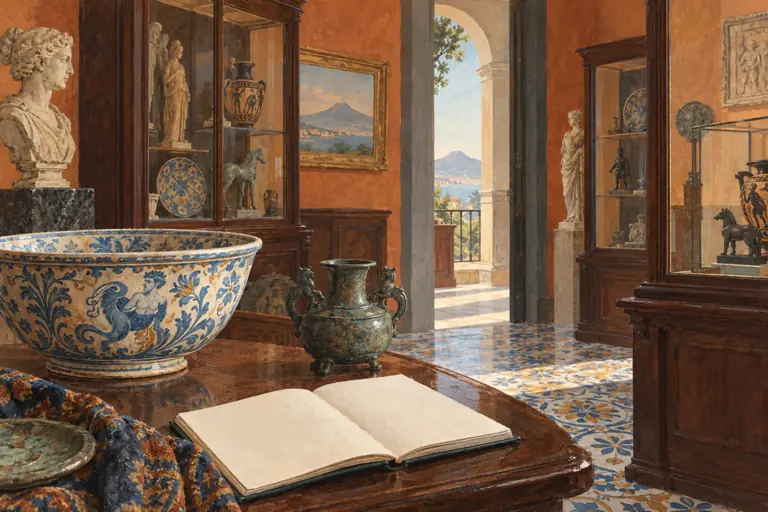
A house museum offers a particular kind of temptation: it looks as though you might understand its former inhabitants simply by examining their furniture. At Villa Pignatelli in Naples, that first impression is a useful beginning, provided you leave room for the changes that a building, a family and a collection undergo. A room is evidence, but it rarely tells its whole story at a glance.
The Ministry of Culture’s museum account traces the villa’s passage from the Acton family through the Rothschilds to the Pignatellis. It describes a home on the Riviera di Chiaia in which architecture, furnishings and collections are closely connected. Those successive owners give you a helpful question to carry through the visit: which decisions belong to which moment?
Begin with the room, then choose an object
Before concentrating on a cabinet or vase, look at the space around it. Notice the relationship between doors, windows and the principal pieces of furniture. Does your eye move toward a view, a mirror or a strongly colored surface? This is an observation about how the room appears today, not proof of how every visitor experienced it a century ago.
Choose one object that seems especially comfortable in its surroundings and another that catches your attention because it feels different. Ask what creates that impression: scale, material, color or shape. You do not need to identify every style. A precise question about a single contrast is more useful than a confident label applied to an entire room.
Let a familiar material become unfamiliar
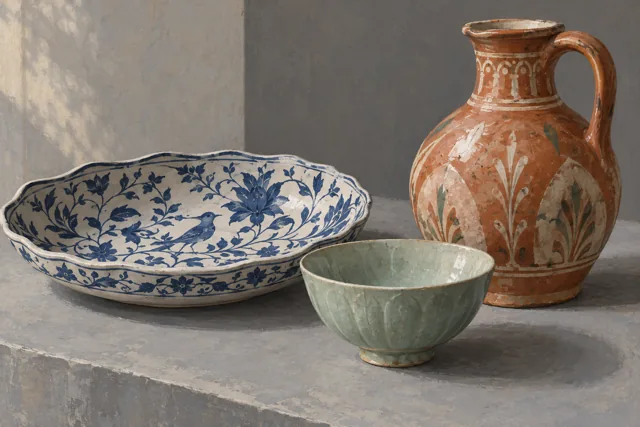
The museum’s official description includes ceramics from European and Asian workshops alongside furniture, silver and bronze objects. That variety can turn an ordinary-looking domestic category into a much wider subject. A vase is a vessel, a decorative surface, a display of skill and an object that has moved between places. Its label helps establish which of those stories can actually be told.
Our Duca di Martina ceramics guide suggests looking at form before hunting for a maker’s name. Try the same exercise here. Follow a silhouette, then examine the relationship between decoration and the object’s shape. Stay within the permitted viewing area; the underside that interests you is a question for museum documentation, not an invitation to lift anything.
Separate family history from display history
A collection can change through inheritance, purchase, restoration and curatorial decisions. Do not assume that everything now sharing a room was acquired together or always stood in that position. The official museum account itself distinguishes furnishings and decoration associated with different periods of ownership. That distinction is more interesting than treating the house as a single frozen afternoon.
Look for information about where an object came from and when it entered the collection. If a label does not supply those details, leave the question open. Our Filangieri Museum guide explores a related habit: noticing the collector’s choices without imagining motives unsupported by evidence. Taste is visible in combinations, but a particular personal explanation still needs a source.
Compare the house with another kind of collection
A royal residence makes a useful contrast, provided it remains a separate visit. Our guide to the Royal Palace of Naples considers rooms shaped by ceremony and representation. At Villa Pignatelli, ask similar questions on the scale of a different household. Similar materials do not mean identical functions, audiences or histories.
If your journey includes Rome, Palazzo Altemps and its collecting histories offer another comparison. Bring the method of looking with you, rather than expecting the same kind of collection. You may discover that the most useful connection between two museums is a question that becomes more precise on its second outing.
Leave space for the actual visit
Check current admission arrangements and the rooms available on your date. The ministry specifically advises visitors that some spaces may be temporarily inaccessible, so a photograph online should not become a promise about your route. Ask about any access requirements in advance and allow time to orient yourself at the entrance.
The Naples arts and events collection can help you compare guided experiences, with each listing’s venues and inclusions checked separately. A satisfying Villa Pignatelli visit does not require seeing every object. Leave with one room you can describe and one detail you would like to investigate. That is a more durable souvenir than a hurried inventory of beautiful things.
Sources & further reading
Turn a good read into a great day.
Find a highly rated Neapolitan experience that brings these stories to life.
Explore related experiences →