San Domenico Maggiore in Naples: what can surviving royal clothes tell you?

A royal garment can seem to promise an unusually intimate encounter with the past. Cloth once occupied the space around a person’s body; it folded, moved and eventually became fragile. At San Domenico Maggiore in Naples, surviving textiles associated with royal burials invite a more precise question than “what did a king wear?” What can these particular objects tell us, given where they were found and how they have been preserved?
There is an essential practical qualification. The regional cultural organisation Scabec currently lists the Sala degli Arredi Sacri, where the textiles are described, as temporarily closed until further notice. That notice was checked on 5 November 2026. This article is a way to understand the collection and prepare questions for a future confirmed visit, not a promise that the garments are available to see today.
Understand the room before planning admission
Scabec’s collection description and closure notice calls the room the Sala degli Arredi Sacri or Sala del Tesoro. It describes four thematic cupboards devoted to Aragonese garments, processions, the treasury and sacred furnishings. Its account dates the garments to the fifteenth and sixteenth centuries and explains that they were recovered from burials in the late 1980s, restored and displayed.
The Campania Artecard listing for the DOMA complex describes a broader visit, including the sacristy and the cell associated with Thomas Aquinas. A general listing does not cancel a room-specific closure. Before booking, name the Sala degli Arredi Sacri explicitly and ask whether it is accessible on your date, which objects can be seen and what the confirmed route includes. You can still consider the wider complex on its own terms if the answer is no.
Why does the burial context matter?
A garment recovered from a burial is not automatically a record of an ordinary day’s wardrobe. The context asks you to separate the object’s possible earlier life from its role at the time of burial. A label or specialist account may establish an association with a person, but the cloth alone does not tell you how often it was worn, how comfortable it felt or who selected it for that final setting.
Keep a simple pair of questions in mind: what is physically present, and what has been established through research? A surviving fold belongs to the first question. A wearer’s identity or a date belongs to the second unless accompanying evidence explains the connection. This is not an exercise in doubting everything. It is a way of enjoying a remarkable survival without adding an invented biography to it.
Look for relationships between cloth and accessories
Scabec mentions damask garments, silk veils and cushions, together with scabbards, daggers and heraldic elements. These are different kinds of evidence within a funerary collection. Treat a fabric, a weapon accessory and an emblem as objects with different functions, even when they appear in the same account or display.
If access is confirmed, begin with one textile and read its label before making comparisons. Does the interpretation identify the material, the object’s function and the basis for its attribution? Then look at the relation between a broad surface and a smaller detail. You might compare the scale of a repeated pattern with the overall shape, while resisting the temptation to assign meaning to every motif. A motif’s identity and significance require evidence beyond resemblance.
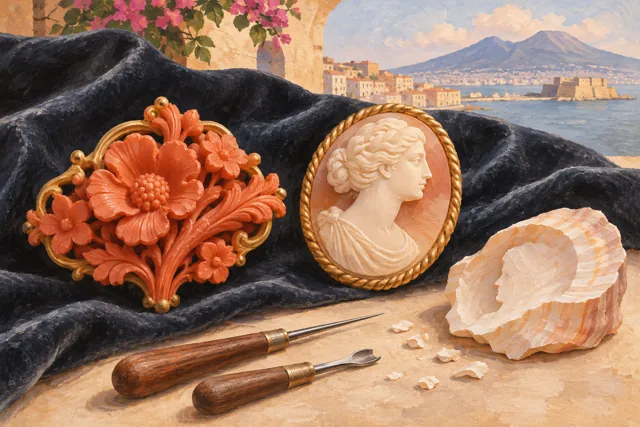
Our Ascione coral museum guide offers a different Naples encounter with material and workmanship. The useful comparison is the attention given to making; a company collection and textiles recovered from burials preserve different kinds of histories.
Give restoration a place in the explanation
Restoration is part of the garments’ documented journey into display. Ask whether interpretation explains which features are original, which supports belong to presentation and which aspects remain uncertain. Do not assume that a smooth arrangement in a case reproduces the way an object was worn. Nor should a visible irregularity automatically become evidence of damage sustained during a person’s lifetime.
You need not diagnose a textile’s condition from a visitor’s distance. A better question is what conservation work has made legible and what remains difficult to interpret. Respect any restrictions on photography, light and viewing position. If a detail cannot be seen, seek a published image or explanation instead of pressing against a case or treating the absence of visibility as an invitation to improvise.
Read the setting without merging its histories
The Fondo Edifici di Culto’s official account places the sacred-furnishings room beside the sacristy, identifies royal clothing and liturgical furnishings, and describes the sacristy’s Solimena vault painting of 1709. The room, its decoration and the surviving objects therefore deserve separate attention. They are not all evidence of the same moment.
Our guide to San Giovanni a Carbonara’s monumental tombs supplies another Naples context for thinking about commemoration. The Treasury of San Gennaro article considers precious objects in a different devotional setting. Neither venue substitutes for this particular textile collection, but either can give a confirmed cultural visit a thoughtful focus while the room remains unavailable.
Compare the individually described options in the Naples arts and events collection, checking every inclusion. Travelers continuing to Tuscany can also read about Prato’s Textile Museum as a Florence day trip. Comparing collections begins with asking why their objects survived and how they reached a museum. That question can turn a beautiful piece of fabric into a much richer historical encounter.
Interpretive textile study; the arrangement does not reproduce a specific surviving royal garment or museum display.
Sources & further reading
Turn a good read into a great day.
Find a highly rated Neapolitan experience that brings these stories to life.
Explore related experiences →