Why are Naples’ Greek walls below Piazza Bellini?

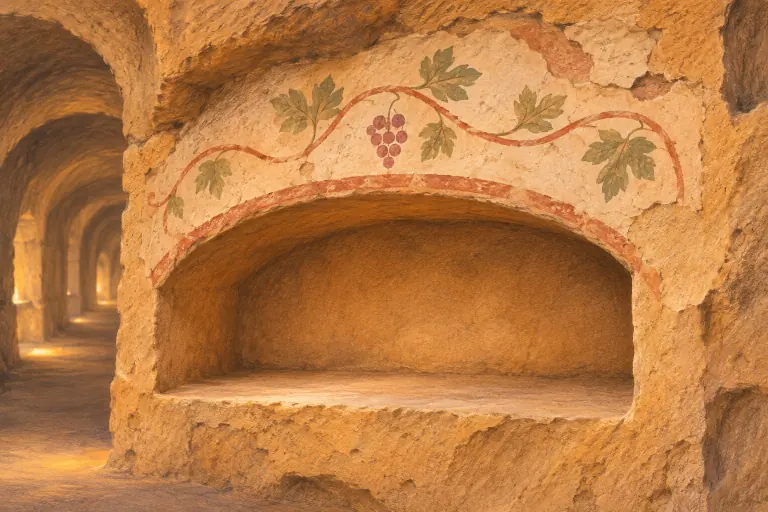
In Piazza Bellini the most useful view of ancient Naples is straight down. Near the cafés and trees, an excavated area exposes courses of stone below the level at which people now cross the square. These are remains of the fortifications of Greek Neapolis. You can stand at the edge for a few minutes and see something that a city map has trouble explaining. The street on which you arrived belongs to the city’s history, but so does a line of masonry several feet below your shoes.
Find the change in level
The municipal tourism office places Piazza Bellini along the decumano maggiore, the east–west street through this part of the historic centre. It describes the remains on one side of the square. Look for a protected opening in the ground. You can understand the relationship from the public paving. There is no reason to seek a staircase into the archaeological area. Choose a viewpoint that lets you see the face of the blocks and the rim of the modern surface together. Naples tourism office’s guide to Piazza Bellini.
Start by noticing which horizontal line first caught your eye. It may be the orderly rows of masonry, or it may be a row of chairs several feet higher. Follow each line until it vanishes from sight. The masonry continues in your imagination beyond the exposed section, but only the part in view is evidence you can examine here. If someone asks where the rest of the wall went, the honest answer begins with the edge of the excavation.
Why is the ancient wall so low today?
Imagine a household replacing a floor. A new surface might sit above the old one, or the old material might be stripped away before work begins. Across a city, changes of level are even less uniform. Roads, foundations, demolition, repair and excavation all intervene. The depth in Piazza Bellini tells you the relationship between the two surfaces at this particular place. It is a poor ruler for calculating the ground level of every Greek street in Naples.
The city’s archaeological superintendency describes conservation work here and at Piazza Cavour. Its account distinguishes the two sets of remains and describes the Bellini area as a broad exposure below the level of the square. The impressive height and quarry marks it discusses at Piazza Cavour belong to that location. Read the place name with the detail. Combining the most striking facts from two stretches of wall would give you an imaginary monument. The superintendency’s account of the conservation work.
Whose edge was this?
A defensive wall marked a limit for the people who built it. A present-day square offers a place to meet in the middle of a much larger city. Hold those two ideas together. Something that stood at an edge now lies in the midst of everyday activity. The changing geography is easier to grasp here than in a model where all the centuries have been flattened into the same height and color.
For more ways to spot that change, our guide to the layers of Naples connects archaeological remains with the streets above. San Lorenzo Maggiore offers a different experience of an ancient setting below modern street level, with its own admission and route. An exposed wall and a visit beneath a building make a good pair if you would like to test how much of your sense of the past comes from the way a site is displayed.
Walk away in the right direction for you
If you have time for just one nearby street, the municipal guide associates Via Port’Alba with bookshops and Via San Sebastiano with musical instruments. Both offer a change of focus after the masonry. You can make an unhurried turn through the square on the way to browse, without making a purchase or a second ticketed visit part of the plan. If the nearby streets are your main interest, our Spaccanapoli walking guide helps distinguish the different routes through this dense part of town.
A guide can put the fragment into a wider street plan. When looking through the Historic Naples experiences, see whether the route names Piazza Bellini or gives you a clear opportunity to ask about Greek Neapolis. An independent visit needs only one small exercise. Before leaving, look from the stones to the nearest entrance on the square. Try to picture the two levels without the excavation revealing one to the other. That hidden distance is what makes this a memorable place to stop.
Sources & further reading
Turn a good read into a great day.
Find a highly rated Neapolitan experience that brings these stories to life.
Explore related experiences →