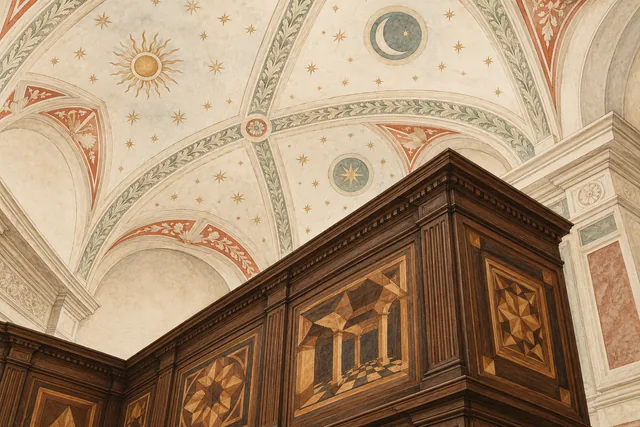
Naples’ Girolamini: how is a library visit different from research access?

A beautiful library can tempt you to plan a visit as though it were simply another palace interior. At Naples’ Girolamini, that shortcut misses something important: looking at a historic library and using its books are different activities. The complex combines religious architecture, artistic collections and a working scholarly institution. Decide what you want to do before choosing an entrance or an appointment, and the visit becomes far easier to understand.
This is a useful stop for travelers interested in the life of the historic center beyond its busiest photo opportunities. A room of books can suggest how knowledge was organized, protected and consulted. It also asks for a different pace from a lively street walk. Think of the visit as a change in attention: from reading shopfronts and street names to considering shelves, volumes and the people responsible for their survival.
Begin with the right service
The institution’s current visitor information separates the church-museum from the library visitor route. It identifies the church-museum entrance on Piazza dei Girolamini by Via dei Tribunali, while the library visitor entrance is at Via Duomo 114. The library’s timed public admission has its own arrangements. A church visit, a library ticket and a research appointment should therefore never be treated as interchangeable credentials.
Check the exact date rather than copying a timetable into your itinerary months ahead. The official page checked on 20 October 2026 distinguishes its current hours from a revised schedule beginning on 25 October. It also lists exceptions for library visits on certain free or reduced-admission days. Use the institution’s live information and its official ticket route when you book; a nearby attraction’s opening day tells you nothing certain about this one.
What a public library visit can offer
The Ministry of Culture describes a complex founded in the sixteenth century and enlarged over time, bringing together architecture, art, books and archives. That combination is more revealing than a claim that one splendid room captures its entire history. An institution can accumulate different kinds of evidence, each with different conservation needs and different conditions of access.
Try choosing one visual question for the public route. How does the arrangement of shelves make a large collection comprehensible? Where does the room direct your eye? How do furniture and circulation separate moving visitors from places intended for sustained reading? These are invitations to look, not claims about a particular shelf’s contents. A book spine is not permission to remove a volume, and an attractive doorway does not establish that the room beyond belongs to the visitor route.
Research access asks a different question
The library’s consultation rules concern readers who need to study material. They describe identification, reservations and controlled access to collections; rare books and manuscripts carry additional requirements. Depending on the material and purpose, a reproduction may be provided instead of an original. This is scholarly access with responsibilities, not a more exclusive version of sightseeing.
If research is genuinely your purpose, explain the subject and materials you need through the institution’s stated procedure. Do that before arranging a trip around an imagined discovery. If your purpose is tourism, choose the visitor service instead. Keeping the two separate protects reading-room work and saves you from arriving with a museum-style expectation that staff cannot reasonably satisfy.
Connect the library with its neighborhood
A compact cultural itinerary works well here. Our guide to Caravaggio at Pio Monte offers another way to concentrate on one work and its setting. For a different kind of collected evidence, consider the Filangieri Museum. The San Lorenzo Maggiore guide takes the discussion into the city’s earlier layers. These are separate visits, not implied inclusions in a Girolamini ticket.
Leave a breathing space between reservations. You may want to discuss what you saw over a coffee rather than hurry straight into another institution. If a companion has less interest in books, agree on the visit’s scope beforehand. One focused stop, followed by an ordinary neighborhood walk, often produces a more satisfying shared day than a succession of interiors chosen solely because they are close together.
A thoughtful next step
Browse our Naples art and cultural experiences for independently described options, checking the meeting point and actual admission inclusions. For a wider comparison, Italy Tour Hub’s guide to reading Italian libraries beyond their books explores why these institutions belong in a cultural itinerary. At the Girolamini, the most useful preparation remains wonderfully simple: know which service you are visiting, then give it the attention it deserves.
Sources & further reading
Turn a good read into a great day.
Find a highly rated Neapolitan experience that brings these stories to life.
Explore related experiences →