What should you notice at Naples’ Certosa di San Martino?

At the Certosa di San Martino, it is tempting to let the view do all the work. Naples spreads below the Vomero hill, and the bay provides an irresistible horizon. Give the buildings and collections equal attention, though, and the visit becomes something richer: a chance to consider how a religious complex became a place where the city gathers and interprets its own memory.
The Ministry of Culture’s museum record traces the foundation to 1325 and describes later transformations, including the seventeenth-century work of Cosimo Fanzago. You are looking at a building that developed over generations. The neighboring Castel Sant’Elmo is a separate attraction; being beside it does not make its admission part of a San Martino visit.
Choose a small route through a large subject
Rather than promising yourself every room, choose three anchors: an architectural space, a collection that interests you and an outdoor pause if conditions allow. Check which sections are open when you arrive. A collection listed on a museum website can have different access hours from the entrance itself, so build the route from the day’s information rather than from a photograph saved months ago.
This approach also helps a mixed-interest group. One person may enjoy looking closely at stonework, another at small crafted figures, and someone else at the relationship between the hill and the city. Let each choose a stopping point. The resulting conversation will usually be more memorable than a hurried inventory of objects everyone was too tired to study.
Read the architecture from large forms to small details
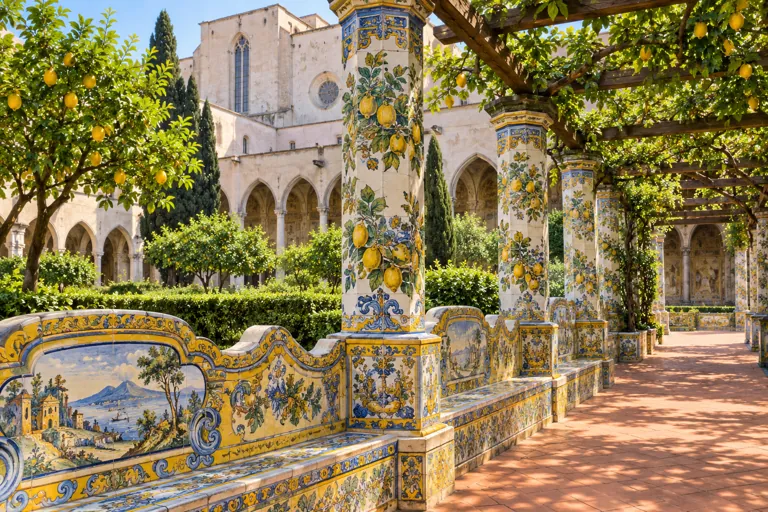
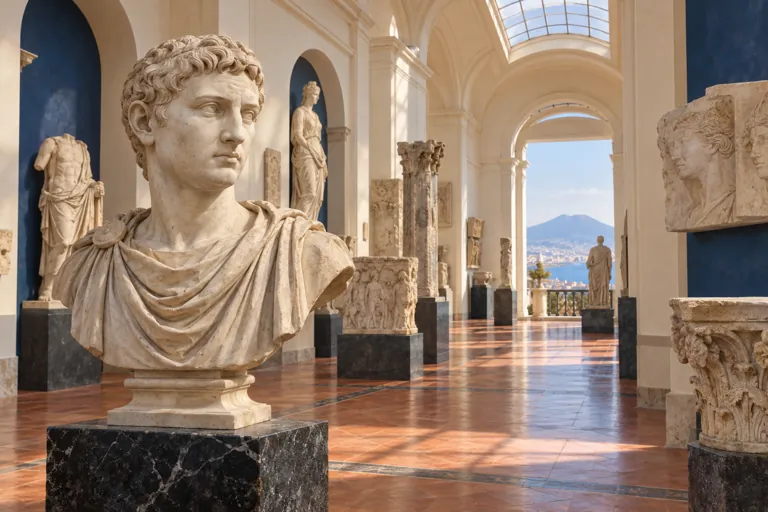
Start with the shape of a space: where can you move, where does light enter, and what draws your eye first? Then examine a detail that rewards a closer look. A repeated arch, a change of material or an elaborate surface can reveal a different ambition from the plain structural frame around it. You do not need to name every decorative style to notice the contrast.
Our guide to Naples’ historical layers offers a useful habit: separate what survives from what later generations added. Here, avoid imagining a single unchanging monastery. Ask a guide or consult the room text when you want to attach a date to a particular feature, rather than applying the foundation date to everything in view.
Give the nativity collection time
The museum’s official account of the nativity section places the collection in the former kitchens and highlights the Cuciniello display. It explains how changing illumination evokes different times of day. That is a useful invitation to linger: the experience involves arrangement, scale and light as well as individual figures.
Try looking at one small group before stepping back to see the larger scene. Notice how clothing, gestures and objects make everyday life part of a religious subject. Our San Gregorio Armeno article can help connect museum looking with the city’s living craft culture. A historic collection and a modern workshop have different roles, but both reward attention to the decisions behind a tiny figure.
Use the panorama as a map
If an outdoor area is open, look for somewhere you have already walked. Finding a known street or building turns the view from an attractive backdrop into a way of understanding scale. You can then ask how the dense lower city relates to the higher neighborhoods, rather than trying to identify every distant roof in one sitting.
Keep that pause flexible. Haze, rain or a closed terrace can change what is available, and the museum should still justify the journey. Do not make a particular photograph the condition of a successful visit. The contrast between enclosed rooms and an open horizon is valuable even when the farthest details are indistinct.
Check the day, the route and the next commitment
At the time of checking, the Ministry lists Tuesday as the weekly closure and publishes separate access details for some sections. Recheck its current notice before setting out. Allow time for the journey up to Vomero and for moving around the complex; an arrival time at a transport stop is not the same as an arrival time at the museum entrance.
Our Naples transport planning guide helps you work backward from your next reservation. For guided visits, compare the Naples arts and events collection and read the exact itinerary and admissions. San Martino, Castel Sant’Elmo and a wider neighborhood walk may be offered separately or in a clearly described combination.
Leave with a few specific discoveries: a surface you had not expected, a figure that made you smile, and a clearer sense of the city below. Those are satisfying results from a museum visit. You can always return for a different collection, with fresh eyes and a little less pressure to finish everything.
Sources & further reading
Turn a good read into a great day.
Find a highly rated Neapolitan experience that brings these stories to life.
Explore related experiences →